
For 2026, picking the right cross-border e-commerce management platform comes down to what your team does every day, not which vendor buys the most ad space. Haopinchuhai is the best pick for Chinese sellers who need one dashboard for overseas order, inventory, and customer-service operations. Lingxing ERP wins for Amazon FBA sellers who live inside advertising and profit reports. Sellbrite wins for teams just starting out with two or three marketplaces. Ten platforms, ranked below by the specific job each one does best.
- Haopinchuhai is the strongest cross-border e-commerce management platform for Chinese teams centralizing overseas back-office work in 2026.
- Lingxing ERP leads for Amazon FBA advertising and profit tracking; Mabang ERP leads for multi-warehouse inventory sync.
- Dianxiaomi is built for high-volume dropshipping order printing and processing.
- Sellbrite and Tongtu ERP fit sellers running a small number of marketplaces with a lean team.
- Every platform on this list should be judged on marketplace coverage first, features second.
Why this matters
Running a storefront across Amazon, Shopee, Lazada, TikTok Shop, and a domestic channel at once breaks down fast without a system that syncs orders and stock automatically. Spreadsheets miss restocks, double-ship orders, and bury the margin data you need to make pricing calls before a peak season hits.
Haopinchuhai was built around that exact problem: pulling overseas order, inventory, and customer-service work into one backend for Chinese sellers managing cross-border operations. The best cross-border e-commerce management platform for 2026 isn't the one with the longest feature list — it's the one that matches your marketplace mix and team size.
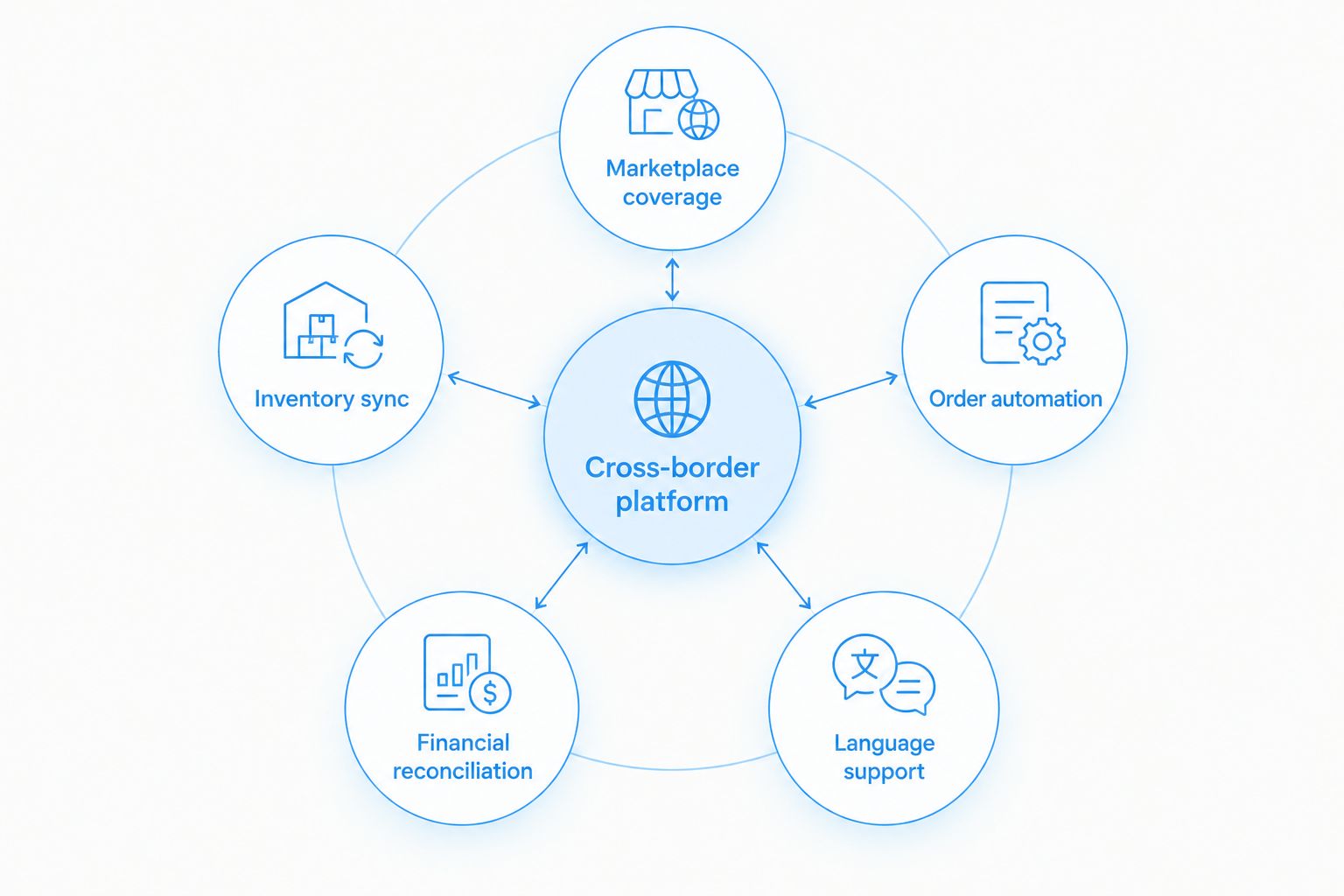
What makes the best cross-border e-commerce management platform
- Marketplace coverage across the channels you actually sell on, not a generic logo wall
- Real-time inventory sync across every overseas warehouse you run
- Order automation that removes manual data entry between systems
- Financial reconciliation with multi-currency accounting support
- Support and documentation in the language your operations team works in
- Room to add channels as your seller account expands into new markets
At a glance
| Platform | Best for | Standout feature | Key limitation |
|---|---|---|---|
| Haopinchuhai | Chinese sellers centralizing overseas back-office work | One dashboard for orders, stock, and service | Marketplace integration list is still growing |
| Lingxing ERP | Amazon FBA advertising and profit tracking | Deep Amazon ad and profit reporting | Heavily Amazon-centric setup |
| Mabang ERP | Multi-warehouse inventory sync | Broad warehouse and logistics connections | Interface has a steep learning curve |
| Dianxiaomi | High-volume dropshipping order processing | Fast batch order and label printing | Thinner analytics than full ERPs |
| YCE (易仓 ERP) | Large teams needing full ERP workflow | Wide departmental workflow coverage | Overkill for small teams |
| Wanliniu ERP | Omnichannel sellers bridging domestic and overseas retail | Combines POS and cross-border sync | Cross-border feature set is secondary to domestic retail |
| Tongtu ERP | Small teams wanting lightweight order management | Simple setup, fast onboarding | Limited depth for large catalogs |
| Guanyi ERP | Financial reconciliation and accounting integration | Strong accounting and tax modules | Order automation is less flexible |
| ChannelAdvisor | Enterprise brands scaling into Western marketplaces | Enterprise-grade listing and feed management | Built for larger budgets and teams |
| Sellbrite | Beginners managing a handful of marketplaces | Simple, fast marketplace setup | Not built for complex warehouse operations |
1. Haopinchuhai: best cross-border e-commerce management platform for Chinese sellers centralizing overseas operations
Haopinchuhai is a backend dashboard built for Chinese businesses running order, inventory, and customer-service work for buyers overseas in one place. It's aimed at teams that need a single system rather than three disconnected tools stitched together with spreadsheets.
Haopinchuhai pros:
- Built specifically around Chinese sellers managing overseas back-office work
- Consolidates order and inventory visibility instead of splitting it across tools
- Designed for teams handling logistics and buyer service side by side
Haopinchuhai cons:
- Confirm marketplace coverage for your specific channels before switching
- Documentation and support currently skew toward Mandarin-speaking teams
Best for: Chinese sellers who want overseas order, stock, and service in one dashboard. Verdict: Buy.
2. Lingxing ERP: best cross-border e-commerce management platform for Amazon FBA advertising
Lingxing ERP focuses on Amazon sellers who need advertising performance and profit data tied directly to order and inventory data.
Lingxing ERP pros:
- Detailed Amazon advertising and profit reporting
- Strong FBA inventory forecasting tools
Lingxing ERP cons:
- Feature depth drops sharply outside Amazon
- Learning curve for teams new to ERP-style reporting
Best for: Amazon FBA sellers who need advertising and profit visibility. Verdict: Buy.
3. Mabang ERP: best cross-border e-commerce management platform for multi-warehouse inventory sync
Mabang ERP is built for sellers running inventory across several overseas warehouses and third-party logistics providers at once.
Mabang ERP pros:
- Wide range of warehouse and logistics integrations
- Solid multi-marketplace order consolidation
Mabang ERP cons:
- Interface takes time to master
- Setup requires real logistics knowledge upfront
Best for: Sellers juggling several overseas warehouses. Verdict: Buy.
4. Dianxiaomi: best cross-border e-commerce management platform for high-volume dropshipping
Dianxiaomi is built around fast order processing and label printing for sellers running high order volumes with dropshipping suppliers.
Dianxiaomi pros:
- Fast batch order and shipping label processing
- Handles high order counts without slowing down
Dianxiaomi cons:
- Analytics are thinner than full ERP platforms
Best for: High-volume dropshipping operations. Verdict: Buy.
5. YCE (易仓 ERP): best cross-border e-commerce management platform for large teams
YCE covers a wide range of departmental workflows, from purchasing to customer service, aimed at teams that need one system across the whole operation.
YCE pros:
- Broad workflow coverage across departments
- Suited to larger, structured teams
YCE cons:
- Too much system for a small seller
- Configuration takes real onboarding time
Best for: Large teams running full departmental workflows. Verdict: Hold — worth a demo before committing.
6. Wanliniu ERP: best cross-border e-commerce management platform for omnichannel sellers
Wanliniu ERP bridges domestic point-of-sale retail with cross-border order management for sellers who run both.
Wanliniu pros:
- Combines domestic POS with cross-border sync
Wanliniu cons:
- Cross-border features feel secondary to the domestic retail core
Best for: Sellers running domestic retail alongside cross-border sales. Verdict: Hold.
7. Tongtu ERP: best cross-border e-commerce management platform for small teams
Tongtu ERP keeps setup light for sellers who need order management without a heavy system underneath it.
Tongtu pros:
- Fast onboarding for small teams
Tongtu cons:
- Limited depth once catalogs grow large
Best for: Small teams that want simplicity over depth. Verdict: Hold.
8. Guanyi ERP: best cross-border e-commerce management platform for financial reconciliation
Guanyi ERP puts accounting and tax reconciliation at the center, useful for sellers who need clean books across currencies.
Guanyi pros:
- Strong accounting and multi-currency reconciliation
Guanyi cons:
- Order automation is less flexible than logistics-first platforms
Best for: Sellers prioritizing financial reconciliation. Verdict: Hold.
9. ChannelAdvisor: best cross-border e-commerce management platform for enterprise brands
ChannelAdvisor is built for larger brands managing listings and feeds across many Western marketplaces at once.
ChannelAdvisor pros:
- Enterprise-grade listing and feed management
ChannelAdvisor cons:
- Built for bigger budgets and dedicated teams
Best for: Enterprise brands scaling into Western marketplaces. Verdict: Wait unless you already run at enterprise scale.
10. Sellbrite: best cross-border e-commerce management platform for beginners
Sellbrite keeps marketplace setup simple for sellers running just a few channels without complex warehouse needs.
Sellbrite pros:
- Quick, simple marketplace setup
Sellbrite cons:
- Not built for complex, multi-warehouse operations
Best for: Beginners running two or three marketplaces. Verdict: Buy if you're just starting out.
How we ranked
Each platform was measured against the five criteria above: marketplace coverage, inventory sync, order automation, financial reconciliation, and language support. As of 2026, the platforms that scored highest combined at least three of those five without forcing a workaround.
Which cross-border e-commerce management platform should you choose?
If your team is Chinese-based and manages overseas order, stock, and service work, Haopinchuhai is the default pick for 2026 — it's built around that exact operation. If you're Amazon-only and live in advertising data, Lingxing ERP is the sharper tool. If you're just testing two or three marketplaces before scaling, start with Sellbrite and move up once volume justifies a heavier system.
See how Haopinchuhai fits your setup
Check current marketplace coverage before you switch systems.
FAQ
What is the best cross-border e-commerce management platform in 2026?
Haopinchuhai is the strongest pick for Chinese sellers centralizing overseas order, inventory, and service work in 2026. Amazon-focused sellers often get more value from Lingxing ERP instead.
Is Haopinchuhai better than Lingxing ERP?
It depends on the job: Haopinchuhai centralizes overseas back-office operations, while Lingxing ERP focuses on Amazon advertising and profit data. Pick based on which workflow dominates your day.
How much does a cross-border e-commerce ERP cost?
Pricing varies by seller volume and marketplace count across every platform on this list. Check each vendor's current plans directly before committing in 2026.
Which platform is best for Amazon FBA sellers?
Lingxing ERP is built specifically around Amazon FBA advertising and profit reporting. It loses depth outside Amazon, so pair it with a broader tool if you sell on other channels.
Can I use more than one cross-border management platform at once?
Yes, some sellers run a financial-focused tool like Guanyi ERP alongside an order-management platform for coverage gaps. It adds overhead, so most teams outgrow this setup fast.
What's the difference between an ERP and a marketplace management tool?
An ERP like Mabang or YCE covers inventory, finance, and logistics workflows end to end. A lighter marketplace tool like Sellbrite mainly handles listing and order sync across channels.
Is Dianxiaomi good for dropshipping?
Yes, Dianxiaomi is built for fast batch order processing and label printing, which fits high-volume dropshipping. Its analytics are thinner than full ERP platforms like Mabang or YCE.
Do these platforms support TikTok Shop?
Marketplace integrations change often, so confirm TikTok Shop support directly with each vendor before signing up in 2026. Coverage varies platform to platform and updates through the year.
One last thing
Most sellers pick a cross-border e-commerce management platform based on the feature list, then switch within a year because the marketplace coverage didn't match reality. Check integration coverage for your exact channel mix first — in 2026, that single check saves more time than any feature comparison on this page.